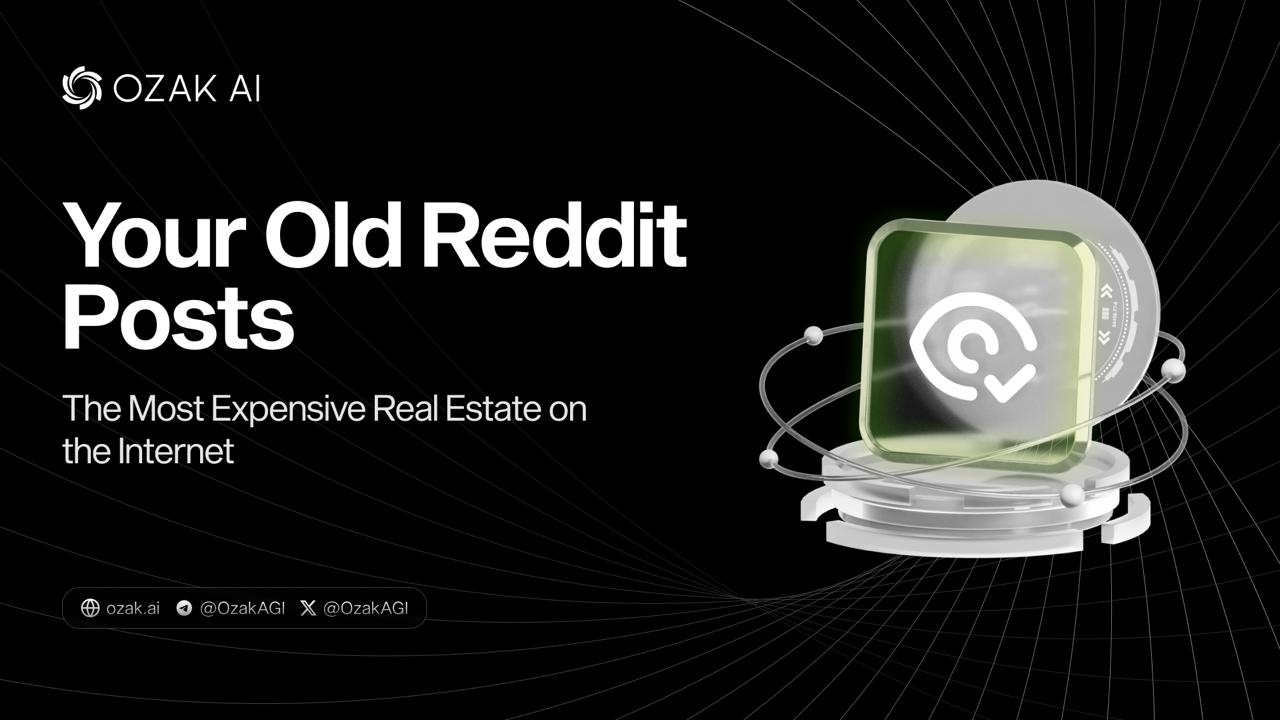
Your Old Reddit Posts
Somewhere on Reddit, there's a comment you wrote in 2011. Maybe it was a complaint about your cable company. Maybe it was a recipe for pad thai. Maybe it was you arguing with a stranger about Game of Thrones at 2 AM. You forgot about it by the next morning. You probably forgot you even had a Reddit account.
That comment, the one you don't remember writing, is now worth more per word than beachfront property in Malibu.
This isn't a joke. In early 2024, Reddit signed a deal worth a reported sixty million dollars a year with Google to license its content for AI training. Then it went public. Its entire valuation, the reason it became a real company on the stock market, leaned heavily on the fact that it owns nearly two decades of human conversation. Conversation written by you. For free. While you were procrastinating at work.
This is the part of the AI boom that nobody is really talking about. The arguments you see online are about which chatbot is smarter, which company has the most chips, and whether agents will take your job. Those are fine fights to have. But underneath all of it, there's a much quieter war happening, and it's the one that will actually shape what the internet looks like in five years.
It's the war over the data itself.
The buffet that ate the internet
For about fifteen years, the internet ran on a simple, unspoken deal. You posted things. Platforms hosted them and made money on ads. Search engines indexed them so other people could find your stuff. Everyone got something out of it, more or less.
Then AI companies showed up with the world's largest spoon and started scooping.
OpenAI, Google, Anthropic, Meta, and a dozen others quietly vacuumed up everything they could find. Reddit posts. Stack Overflow answers. Wikipedia articles. Personal blogs that hadn't been updated since 2014. Forum threads from old PHP boards that people forgot to take down. News articles. Tutorials. Comments. Recipe blogs where someone wrote three thousand words about their grandmother before getting to the actual lasagna.
They didn't ask. They didn't pay. They didn't really hide it either. The general assumption was that the internet was just there, like air, and you could breathe as much of it as you wanted.
Here's the thing though. Without that data, none of the AI models you've heard of would exist. ChatGPT didn't learn to write from a grammar textbook. It learned to write because it read roughly a trillion words of human writing. Most of those words were typed by people who had no idea they were training a machine.
That was the buffet. It was free, it was open, and it lasted until it didn't.
The walls go up
Around 2023, a few people sat down and did the math, and they realized something uncomfortable. The data that AI companies were scraping for free wasn't just useful. It was the single most valuable resource of the next decade. Compute can be bought. Models can be copied. Talent can be poached. But the actual collection of human-written text on the open internet is finite. It can't be magically regenerated. And whoever controls access to it controls almost everything downstream.
So the platforms started locking the gates.
- Reddit blew up its free API in 2023, killed off most third-party apps, triggered a user revolt, and then signed exclusive licensing deals with the same AI companies it had just locked everyone else out for.
- Stack Overflow did basically the same thing, and watched in real time as longtime users started deleting their answers in protest.
- Twitter, now X, cranked up its API prices to ridiculous levels overnight.
- The New York Times sued OpenAI for billions, claiming that ChatGPT could basically recite their articles word for word.
Then Cloudflare did something genuinely wild. They rolled out what's essentially a toll booth for AI crawlers. If your bot wants to scrape websites that sit behind Cloudflare, you now have to pay. They called it "pay per crawl." It was the moment the open web officially started charging admission.
What used to be a free buffet is now a Michelin restaurant, and the people who actually grew the food are still standing outside in the rain.
The thing nobody planned for
There's a problem with this setup, and it's one of those problems that sounds almost funny until you sit with it for a minute.
If the open internet turns into a series of paywalls, where will the next generation of AI models get fresh data?
The original buffet worked because billions of humans were writing things every day for human reasons. We wrote because we wanted to share something, complain about something, or help a stranger fix their broken washing machine. The data was good because it was real. It came from actual people with actual lives.
What happens when the open well runs dry?
AI companies have a tempting answer for this. They can just have AI models generate more training data. Take an existing model, ask it to write a million pages of text, then use that text to train the next model. Boom, infinite data. Problem solved.
Except it isn't.
Researchers have known about this for a while now, and they have a name for it. They call it model collapse. When you train AI on AI-generated content, the models get progressively dumber. They lose the weird, specific, surprising details that made the original data interesting in the first place. They start producing average versions of average versions of average versions. Eventually they collapse into bland, repetitive sludge.
It's the snake eating its own tail. And the more locked down the human internet becomes, the more AI companies will be forced to feed their models synthetic food. Which means the models will quietly get worse, even as the marketing keeps insisting they're getting better.
This is the part where things actually get interesting.
The question hiding in plain sight
If human-written data is the most valuable resource of the next decade, and it can't be regenerated, and the people who originally created it never got paid for it, you start to ask an obvious question.
Why don't the people who wrote the data own it?
This is the question a lot of crypto and decentralized AI projects have been quietly working on for a while. It sounds like a small philosophical concern, but it's actually a massive infrastructure problem. If you wanted to build a system where every contributor to a dataset got credited, paid, and could verify how their work was used, you'd need three things:
- A way to prove who created what.
- A way to track how it gets used downstream.
- A way to send value back to the original creator automatically, without a corporation deciding to be generous.
Sound familiar? Those happen to be the exact problems blockchain technology was built to solve.
This is where decentralized data marketplaces come in. The idea is simple. Instead of Reddit signing a sixty million dollar deal with Google while paying its users nothing, what if the users themselves signed individual micro-licenses for their content? What if every time an AI model trained on your writing, a small payment flowed back to your wallet? What if the model itself could verify, on a public ledger, that the data it was trained on actually came from real humans and not from another AI?
That last part matters more than the money question. Because if model collapse is real, and it is, then the most valuable thing in AI five years from now won't be the smartest model. It'll be access to verified human data. Stuff you can actually prove a person wrote.
There's a growing pocket of projects building exactly this kind of infrastructure, where data, AI agents, and value all move on rails that anyone can audit. Ozak AI is one of the ones working in this direction, treating data provenance and agent accountability as a first-class problem rather than something to clean up later. It's not a magic fix, nothing in this space is, but it's the kind of foundation work that tends to look obvious in hindsight. The companies that figure out the data ownership problem early are going to look like the ones who bought Manhattan when it was still farmland.
What this actually means for you
Most people reading this aren't going to start a data marketplace. That's fine. But the data wars are going to affect you whether you care or not, in a few specific ways.
First, the open internet you grew up with is closing. Search results are going to get worse because publishers will increasingly block crawlers or move their best material behind paywalls. Free information is going to get harder to find, not easier. The "just Google it" era is quietly ending.
Second, AI tools are going to get more expensive. The companies running them are burning through cash, and the data they need is no longer free. That cost has to land somewhere, and it's going to land in your subscription bill. The five dollar a month plan isn't going to stay five dollars a month forever.
Third, and this is the strange one, the value of being a verified human online is about to spike. Right now, your Reddit account is worth approximately nothing to you. In five years, your verified history of human-written content might be a real asset. People are going to start thinking about their digital footprint less like garbage and more like a slow-growing investment. Owning your data, actually owning it, is about to become a thing people care about.
The well, not the bucket
There's an old saying about the gold rush. The people who got rich weren't the ones panning for gold. They were the ones selling shovels.
In AI, that saying has been used for years to talk about Nvidia. They sell the shovels, they got rich, fine. But it's the wrong metaphor for what's coming next.
The next decade isn't going to be a gold rush. It's going to be a water rush. Everyone needs water, constantly, forever. And the people who get rich won't be the ones selling buckets. They'll be the ones who own the wells.
The data is the well. Human-written, verified, traceable data is the well. The companies that control it, or better yet, the systems that let ordinary humans control it together, are going to shape the next phase of the internet.
The good news is that you've been depositing into your own personal well for years. Every comment, every post, every weird late-night thought you typed into a forum. That's your contribution. It mattered. You just didn't know it would.
The bad news is that someone has already drunk most of it for free.
The interesting news is that the rules for what happens next haven't actually been written yet. The platforms are scrambling. The AI companies are scrambling. The lawmakers are five years behind, as usual. And somewhere in the middle of all that mess, there's a real chance to build something where the people who created the value actually get to keep a piece of it.
It's worth paying attention to. Even if you forgot you ever had a Reddit account.