The Eon Cognitive Stack
Walk into any fintech demo today and you'll see the same architecture: A conversational interface plugged into GPT-4 as a financial cosmetic, wrapped around some market data APIs. It looks intelligent. It sounds intelligent. But it's not doing the math.
There is a vast difference between using AI and building intelligence. Many platforms today claim to be “AI-powered,” but structurally, they are just interfaces connected to a generalized Large Language Model (LLM). You ask a question, the system fetches data, sends it to the LLM, and returns a well-written answer. It feels intelligent, but it remains entirely dependent on external reasoning. This is the definition of an “AI wrapper.”
What an AI Wrapper Really Is?
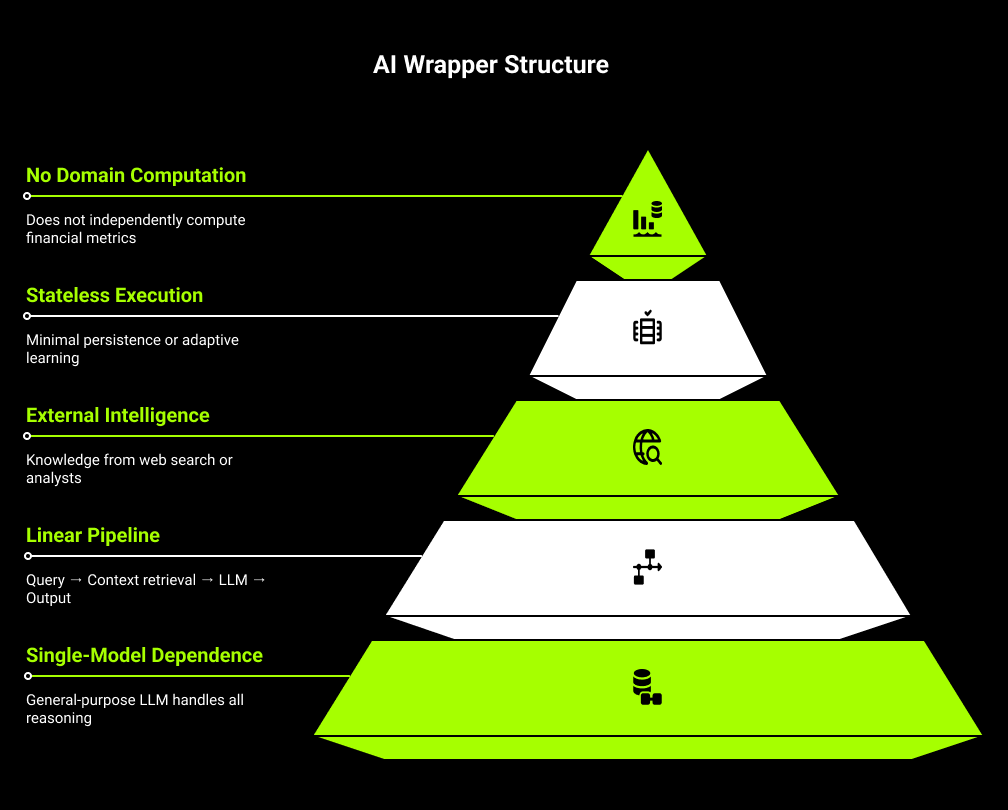
Al Wrapper Structure
An AI wrapper is fundamentally simple. The system gathers information, sends it to a language model, and generates a response. Platforms like Perplexity exemplify this pattern. They are optimized for retrieval, organization, and citation.
An AI wrapper typically exhibits the following structural characteristics:
- Single-model dependence: A general-purpose LLM handles all reasoning tasks.
- Linear request-response pipeline: Query → Context retrieval → LLM → Formatted output.
- External intelligence reliance: Knowledge originates from web search or third-party analysts.
- Stateless execution: Minimal persistence or adaptive learning across interactions.
- No domain-native computation: The system does not independently compute financial metrics or structured forecasts.
If you ask a wrapper, “What do analysts think about Bitcoin?”, it gathers sources and produces a neat summary. However, it does not compute forecasts, run financial models, or independently verify whether analyst opinions match market structure. It presents intelligence; it does not generate it.
Why Eon Is Not an AI Wrapper
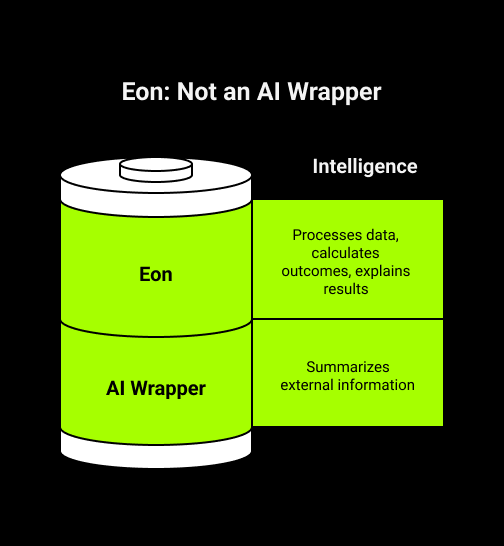
Al Wrapper Structure
Eon does not begin with language; it begins with computation. Before anything is explained in words, the system is actively processing raw market data. Prices, liquidity shifts, and funding rates are not just cited from articles - they are calculated. By the time an LLM enters the process, the heavy reasoning has already occurred. The language model is there to explain the outcome, not decide it.
Rather than functioning as a thin orchestration layer, Eon operates as a multi-layered, agentic, predictive, and verifiable intelligence stack designed specifically for autonomous financial reasoning.
Architecture Comparison
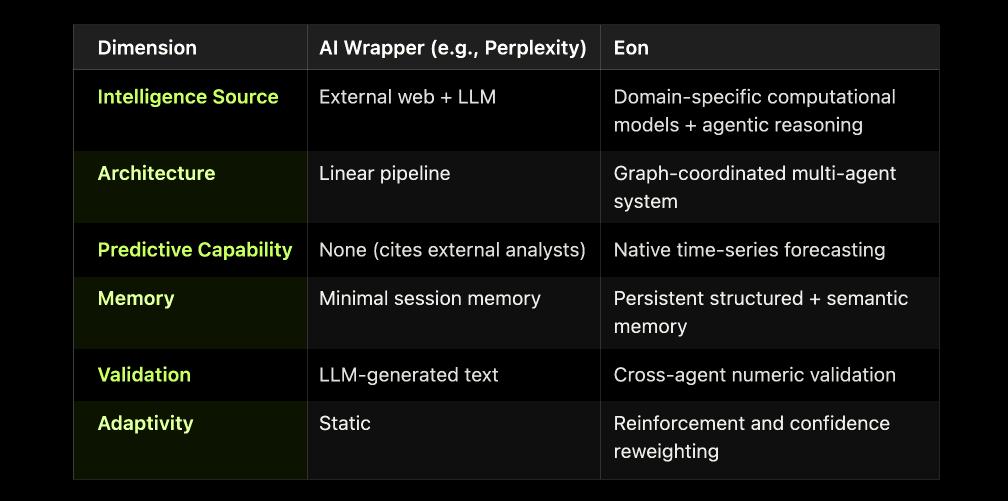
Architecture Comparison
Prediction vs. Summarization in Practice
Presentational Intelligence (The Wrapper Approach):
- User: "Should I buy BTC now?"
- Process: Web search for recent BTC analysis → Send results to GPT-4.
Output: "According to CoinDesk, BTC is trading at $67,420. Analysts from JPMorgan suggest..."
Cognitive Intelligence (The Eon Approach):
- User: "Should I buy BTC now?"
- Process: Intent classification identifies the query → Parallel agent activation triggers internal models.
- Risk Agent: Calculates that adding 10% BTC increases VAR by 4.2% to $2,340.
- Sentiment Agent: Computes news sentiment at +0.65 based on institutional adoption.
- On-Chain Agent: Detects whale accumulation (12 wallets added 2,500 BTC).
Output: "Based on your $50K portfolio with moderate risk tolerance: BTC shows technical momentum (RSI 67) with our models forecasting +8% upside. However, you're approaching overbought territory. Whale accumulation supports the bullish case, but adding 10% BTC increases your portfolio risk 4.2%. Recommendation: 5-7% staged entry - 3% now, 2-4% on pullback to $58,200 support level."
Eon’s Multi-Layer Cognitive Stack
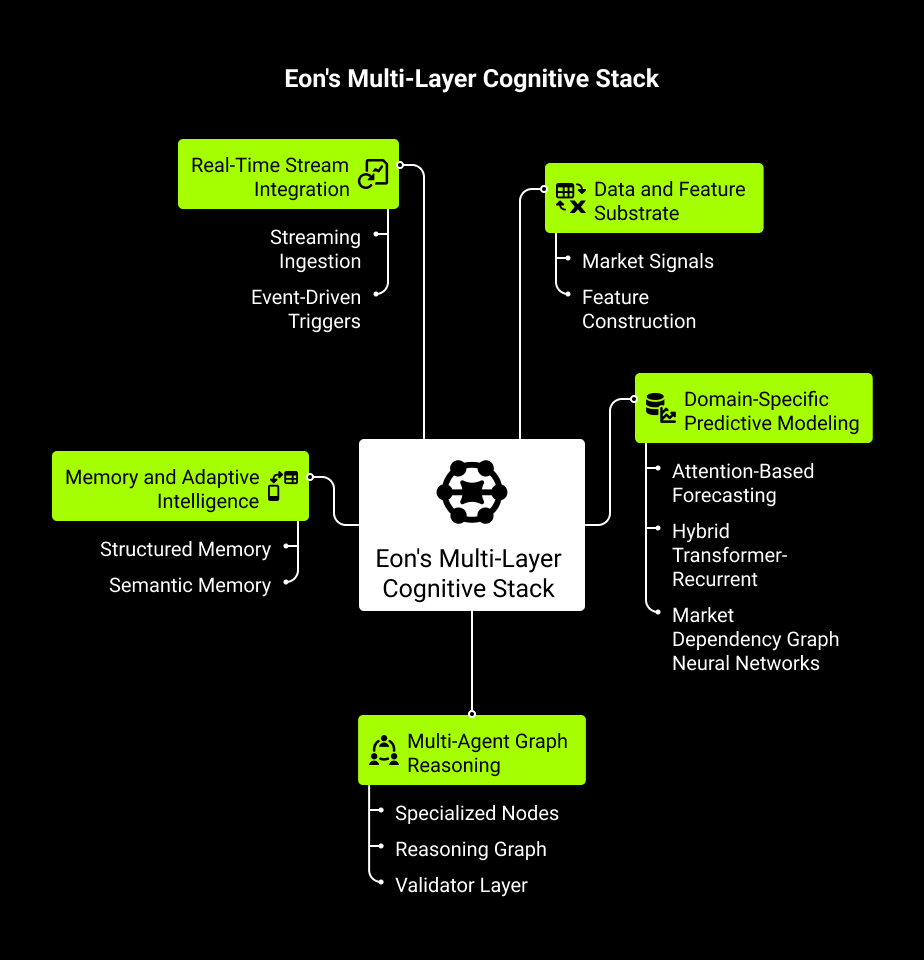
Eon's Multi-Layer Cognitive Stack
Eon is architected as a layered reasoning mesh, where the LLM serves strictly as a synthesis interface.
Data and Feature Substrate
Eon ingests raw market, on-chain, liquidity, and macro signals into a structured processing framework. Unlike wrapper systems that rely on citing external analysis, Eon performs independent feature construction, mathematically computing multi-timeframe OHLCV, technical indicators, supply dynamics, and correlation matrices. A wrapper cites an article mentioning RSI; Eon computes the RSI.
Domain-Specific Predictive Modeling
At its core, Eon relies on specialized time-series architectures, including attention-based forecasting models, hybrid transformer-recurrent volatility learners, and market dependency graph neural networks. These models output probabilistic forecasts, confidence intervals, and risk-adjusted projections. An LLM can narrate probability, but it cannot compute a calibrated forecast with backtested error bounds.
Multi-Agent Graph Reasoning
Eon operates as a graph-coordinated, multi-agent architecture. Specialized nodes (Fundamental Analysis, Technical Analysis, Sentiment, Whale Alerts) operate on domain-specific inputs and exchange inferences via a reasoning graph to reach a weighted consensus. Crucially, a Validator Layer cross-checks numeric outputs and tests forecast consistency before any synthesis occurs.
Memory and Adaptive Intelligence
While AI wrappers are predominantly stateless, Eon maintains dual memory:
- Structured memory: Historical metrics, forecasts, and validation scores.
- Semantic memory: Embedding-based contextual retrieval.
This is not conversational memory; it is model performance memory. The system learns which agents perform reliably in certain regimes, dynamically reweights routing decisions, and improves confidence calibration over time via reinforcement feedback.
Real-Time Stream Integration
Eon incorporates streaming ingestion and event-driven reasoning triggers. When significant structural changes occur - such as liquidity contractions or volatility spikes - reasoning processes are actively triggered. A wrapper reacts when prompted by a user; Eon reasons continuously when the market changes.
Conclusion
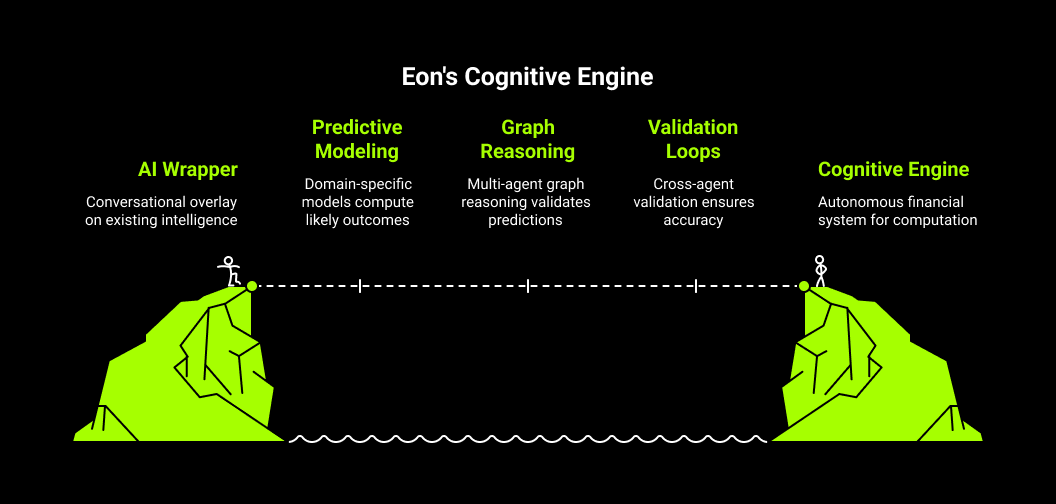
Eon's Cognitive Engine
AI wrappers provide conversational overlays on existing intelligence. They summarize, cite, and format. Eon constructs intelligence through domain-specific predictive models, multi-agent graph reasoning, cross-agent validation loops, and persistent adaptive memory.
Eon does not ask an LLM what will happen. It computes what is likely to happen, validates it, remembers it, and only then explains it. The difference is not incremental; it is architectural. Eon is a cognitive engine for autonomous financial systems.