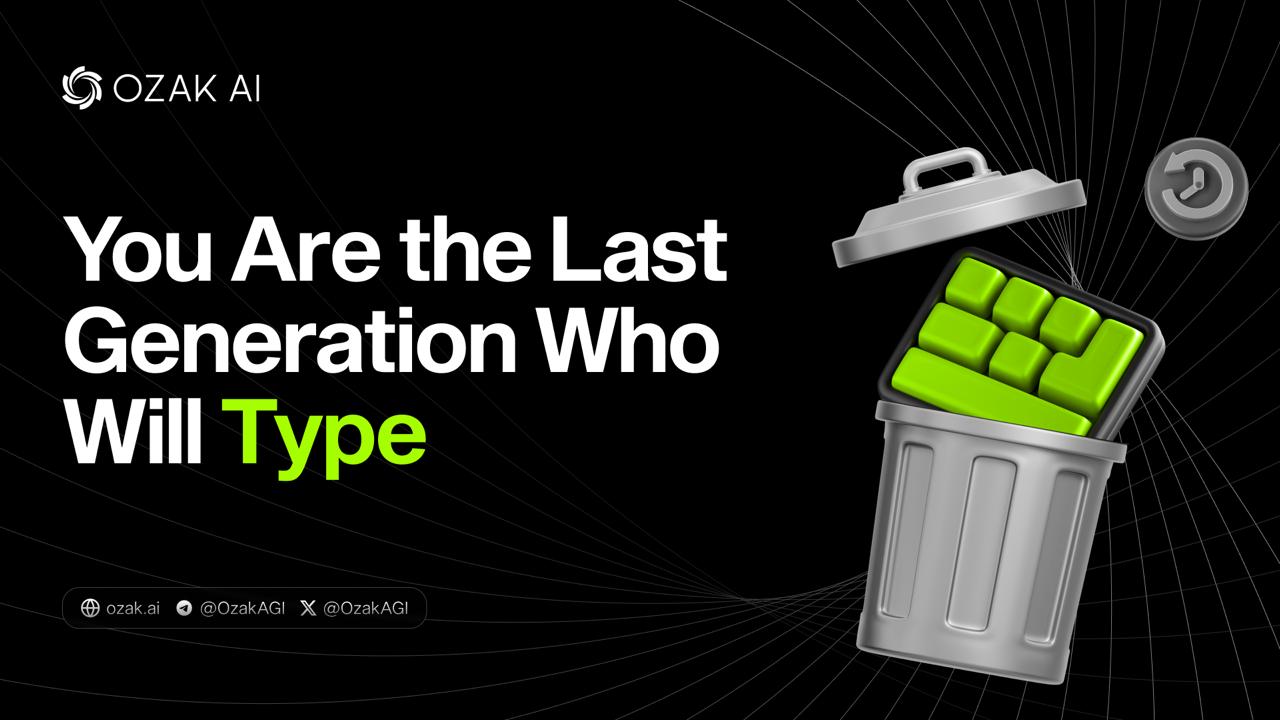
You Are the Last Generation Who Will Type
Picture this. It's 2042. You're sitting at the dinner table with your kid, who is fifteen and slightly embarrassed by everything you do. They ask you what you did at school. You start telling some story about your computer lab, and you mention typing. They stop chewing.
"Wait. You actually typed? Like, with your fingers? On a keyboard?"
You nod. They squint at you the way you squint at people who tell you they once sent a fax.
"That sounds insane."
This is not a stretch. This is roughly the trajectory we are on. And the strange thing is, almost nobody is talking about it directly, even though the signs are everywhere.
You might be the last generation that grows up typing as a primary way of using a computer. Your kids probably won't. Their kids almost certainly won't. The QWERTY keyboard, that little plastic rectangle that has shaped how billions of humans interact with machines for over a century, is quietly walking off the stage.
Let's talk about how it happened, what replaces it, and why this matters way more than it sounds.
The 150 year reign nobody questioned
The QWERTY layout was invented in the early 1870s for mechanical typewriters. The reason the letters are scattered the way they are is not because some genius optimized them for human hands. It's because early typewriter arms used to jam if you typed fast, so the layout was designed to slow you down. That's it. That's the origin story.
That layout then got copied onto every typewriter, every word processor, every desktop computer, every laptop, and eventually every smartphone keyboard on Earth. A design meant to slow humans down became the dominant interface for the most powerful machines in human history.
Think about that for a second. For roughly 150 years, the way most humans have given instructions to machines has been by tapping a specific sequence of plastic squares laid out in a pattern designed for an obsolete technology. We have built entire economies, professions, and education systems around this skill. Typing speed used to be a real thing you put on your resume. Some of you reading this still remember keyboarding class.
And the wildest part? We never really questioned it. We just accepted that talking to a computer means pressing letters in a sequence, like some kind of magic spell.
Why typing was always a bit weird
If you step back from the habit of it, typing is a strange way to communicate.
A normal human speaks at about 150 words per minute. A fast typist hits maybe 80 on a good day. The average is closer to 40. That means every time you type something instead of saying it, you are throwing away two-thirds of your natural speed. You are also using a smaller set of muscles, hunching over, straining your eyes, and turning a fluid thought into a series of discrete finger movements.
Typing also hurts. Repetitive strain injuries, carpal tunnel, neck pain, eye strain. We have built billion dollar industries around mitigating the damage caused by the very interface we use to do most of our work. Standing desks. Ergonomic keyboards. Wrist supports. Blue light glasses. None of this would exist if typing were a natural way for humans to operate.
And then there are the kids.
Watch a four year old try to use a computer for the first time. They don't reach for the keyboard. They poke the screen. They swipe. They talk to it. The keyboard is, to them, a baffling and useless piece of furniture. They have to be taught that typing is how you do things, the same way previous generations had to be taught how to dial a rotary phone.
That tells you almost everything. A real interface should be discoverable by a curious child. Typing isn't.
The replacements are already here
The keyboard isn't going to die because someone invents a single magical replacement. It's going to die because three or four things stack on top of each other and slowly make it irrelevant. That stacking is already underway.
Voice is finally good. Until about 2022, voice recognition was a joke. You would dictate "send Sarah a message saying I'll be late" and your phone would text your aunt the word "spaghetti." Whisper changed that almost overnight. Real-time transcription is now accurate enough across dozens of languages and accents that millions of people are already speaking to their devices more than they type to them. The accuracy curve has flipped. It used to be that typing was reliable and voice was a circus act. Now it's the opposite.
Agents don't need prompts. This is the part most people are sleeping on. The whole reason you "type prompts" right now is because the AI is sitting there waiting for instructions. Once agents become ambient, always running, watching context, listening for cues, you stop instructing them in a formal way. You just say what you need, or you don't say anything at all and they handle it. The prompt box is a temporary artifact of a transitional era. It will look as quaint as the command line does today.
Ambient computing is creeping in. Your watch is listening. Your earbuds are listening. Your car is listening. Your fridge is, weirdly, also listening. The interface is moving from a screen you stare at to a space you live in. In that world, typing makes about as much sense as carrying a typewriter into a conversation.
Brain interfaces are closer than people think. Yes, Neuralink and all the rest. The early demos are crude, but they're real, and they're improving fast. The first version of a thought-to-text interface that an ordinary person might use is probably a single decade away. The first version that an ordinary person prefers is maybe two decades away. Either way, the keyboard is on borrowed time.
What dies when typing dies
This is the part where it gets genuinely strange, because once you remove the keyboard, a lot of other things go with it.
The search bar dies. You don't type a query into Google anymore. You ask. The agent fetches.
The app dies, or at least it shrinks. Apps exist because we needed grids of buttons and forms to navigate. If you can just say what you want, the agent does the navigating for you. The app becomes a backend service that you never see.
The browser as we know it dies. You don't open tabs. You don't bookmark anything. You don't even visit websites in the old sense. The agent visits them on your behalf and reports back. The web becomes a giant restaurant where you never see the kitchen.
Email might die. Or rather, it might become something you supervise rather than something you write. Drafts get composed automatically based on context. You approve, edit by voice, or ignore.
Forms die, finally and gloriously. No more typing your address into seventeen different checkout pages. No more captchas. The agent handles all of that, identity attached.
Notice what's happening here. We're not just losing a peripheral. We're losing an entire way of relating to computers. The keyboard didn't just let you input text. It was the thing that made you, the human, do the work of structuring your request. When the keyboard goes, that work goes too. The machine starts doing more of the thinking about what you actually meant.
That sounds great. It is also a little dangerous.
The part nobody is ready for
Here is the uncomfortable trade-off baked into all of this.
When you type, there is a record. You wrote the words. You hit send. There is no ambiguity about what you meant or who said it. The keyboard, for all its annoyances, is an interface with a built-in audit trail.
When you speak to an ambient agent that acts on your behalf, all of that gets fuzzy. Did you actually authorize that purchase, or did the agent infer it from something you said while half asleep? Was that email really from you, or did your assistant draft it after listening to a meeting? When your agent signed a contract on your behalf, what exactly did it think you wanted?
This is the quiet crisis that nobody is talking about loudly enough yet. As soon as voice and agents become the primary interface, the question of who actually said what, when, and with what authority becomes one of the biggest problems in computing.
This is where the AI and crypto worlds start to overlap in an interesting way. If agents are going to act on your behalf, you need provable signatures attached to their actions. You need a record of what was authorized, by whom, with what context. You need verifiable intent, not just verifiable identity. The web2 model of "log in with your password and hope for the best" was already cracking. The voice-and-agent era will break it completely.
Projects like Ozak AI are part of a small but growing camp building toward this. The bet is that if agents are going to do real things in the real economy, the trust layer underneath them has to be open, auditable, and not owned by whichever big tech company happens to be hosting the voice assistant that month. That isn't going to be optional for much longer. It is going to be the foundation that the next interface stands on, whether people notice it or not.
What this means for you, right now
Most people reading this won't change anything about how they work tomorrow. That's fine. But there are a few things worth knowing.
The skill stack is shifting. Typing speed used to be a job skill. It hasn't been one for a while, but the broader skill of "moving information through a keyboard efficiently" still matters today. In ten years it will matter much less. What will matter is your ability to think clearly out loud, to give good context, to know when to let the agent run and when to grab the wheel. These are different muscles. Start training them.
The way you teach kids will change. If you have young kids, you have probably already noticed that they instinctively talk to devices instead of typing into them. Don't push them back toward the keyboard out of nostalgia. Let them grow into the interface that will exist when they are adults.
Your digital footprint is about to get noisier. Everything you say in front of a listening device is potentially data. Get comfortable with the idea that the boundary between thinking about doing something and the system already doing it is going to shrink. That's powerful when it works for you, and a nightmare when it doesn't.
The keyboard will become a power user tool. It's not going to disappear from Earth. It will become what the mechanical typewriter is now, or what writing in cursive is now. A thing some people still love, a thing professionals in certain niches still use, a thing kids learn as a hobby or a craft. But it will stop being the default way humans talk to machines.
The last typist
There is a quiet, almost funny image at the end of all this. Somewhere out there, a child has just been born who will live their entire life without ever needing to learn QWERTY. They will use computers more powerful than anything you have ever touched. They will spend more hours interacting with machines than you ever did. And they will do it almost entirely without their fingers ever pressing a plastic square in a specific order.
When that kid is twenty-five and you mention something about typing, they will pause for a second and try to picture it. Then they will probably ask, politely, the same question you would ask if someone described churning their own butter.
"Why would you do it that way?"
And you'll smile, and try to explain, and realize halfway through that you don't really have a good answer. You did it that way because that's how it was done. Because the machines needed it. Because nothing better existed yet.
But it does now. And the future, it turns out, is mostly going to be spoken.