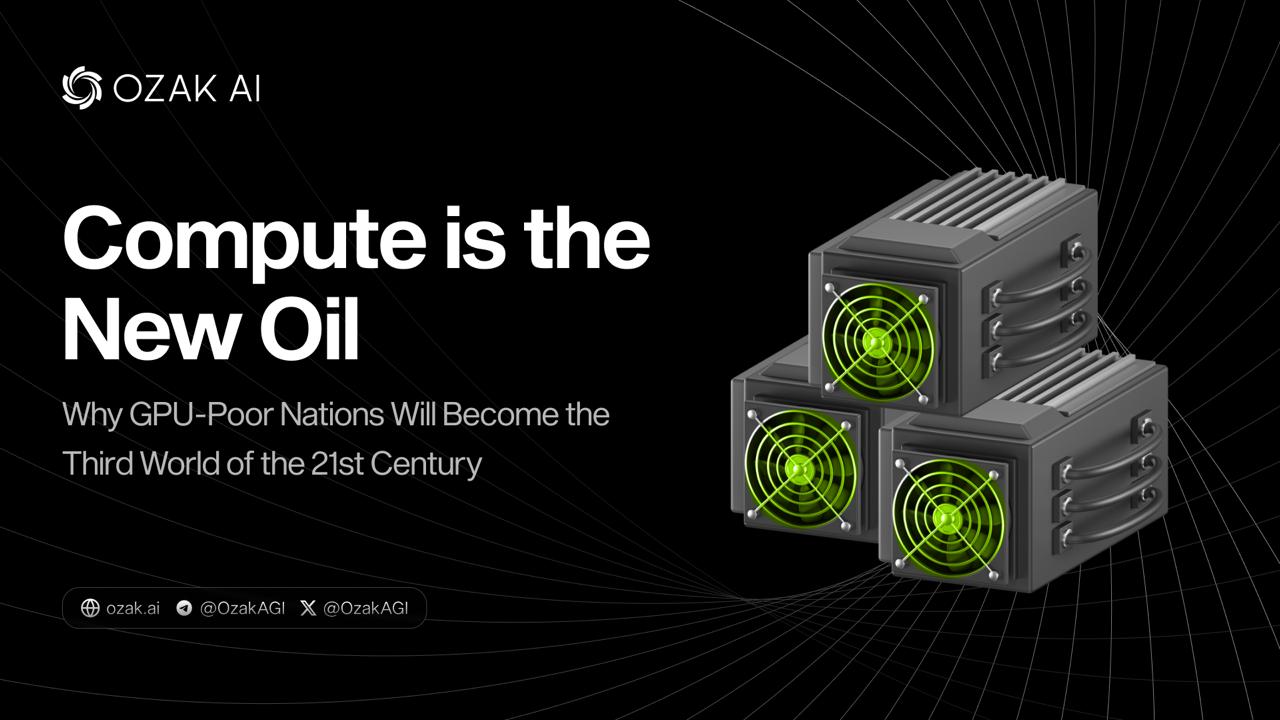
Compute is the New Oil
For the last hundred years, global power was defined by what a country could pull out of the ground. If you had oil, coal, or natural gas, you had leverage. Entire economies, trade routes, and geopolitical systems were built around who controlled these physical resources and who was forced to buy them.
But the map of global wealth is rapidly being redrawn, and the new dividing line has nothing to do with what is buried beneath the soil.
It is about compute.
Processing power is the new oil. Artificial intelligence has moved far past being an experimental tech trend; it is now the core engine of the modern economy. Every major sector - from finance and manufacturing to healthcare and logistics - is becoming heavily reliant on AI to stay competitive. And the raw fuel required to run that engine is compute, driven primarily by GPUs.
Right now, we are witnessing a quiet but massive land grab. A small group of wealthy nations and massive tech corporations are hoarding processing power like a strategic national reserve. They understand a harsh reality: if a country cannot generate its own compute, its economic growth will inevitably hit a wall.
Nations that fail to build or secure this infrastructure - the "GPU-Poor" - are walking into a trap. They will soon find themselves entirely dependent on foreign processing power just to keep their everyday industries running. Instead of exporting valuable goods and services, they will be forced to rent the digital building blocks of the future at a steep, monopolized premium.
We are watching the foundation of a new, tech-driven third world. It is a divide no longer based on geography or physical borders, but purely on who owns the compute, and who is stuck paying a toll just to use it.
The Compute Divide
To understand the scale of this divide, you just have to look at who is actually buying the hardware. Right now, a few massive tech corporations and a handful of wealthy governments are buying up nearly every high-end GPU on the market. They are building multi-billion-dollar data centers that act like modern fortresses of processing power.
If you are a developing nation, or even a mid-sized economy without the massive capital required to build these server farms, you are stuck. You cannot effectively train your own AI models to improve your local healthcare systems, optimize your agricultural output, or modernize your power grids. You simply do not have the hardware to do the heavy lifting.
So, what is the alternative? You rent it.
This is where the trap snaps shut. GPU-poor nations are forced to turn to the very same monopolies hoarding the hardware and pay whatever price they set for cloud computing and AI access. It is a modern, digital version of sharecropping. The local economy generates the raw data, sends it overseas to be processed, and then has to buy it back as a finished product at a premium.
Over time, this system drains wealth from developing regions and funnels it directly into the pockets of a few centralized giants. The gap between the compute-rich and the compute-poor will not just impact the tech sector; it will heavily dictate national GDPs. If your country is stuck paying monthly rent just to use someone else's artificial intelligence, you are not building an independent economy. You are just paying a digital tax to participate in the 21st century.
The Decentralized Way Out
If the story ended there, the future would look pretty grim for anyone outside of Silicon Valley or a few wealthy capitals. But there is a plot twist, and it is built on hardware that already exists in millions of homes and offices around the world.
We have been conditioned to think that artificial intelligence requires massive, multi-billion-dollar server farms to function. That is the centralized model, and it is the reason the compute divide exists in the first place. But there is a different approach: decentralized compute markets. Instead of putting all the processing power inside one giant, heavily guarded warehouse, this model distributes the workload across a massive, global network of individual machines.
Think about a high-end gaming PC sitting in a bedroom in Buenos Aires, or a heavy-duty rendering rig in a small design agency in Nairobi. For most of the day, that hardware sits idle, doing absolutely nothing. Decentralized networks allow the owners of those machines to plug their unused GPUs into a global digital grid. When a local business or a researcher needs processing power to run an AI model, they don't have to go through a massive tech monopoly; they can source it directly from this distributed network.
This creates a profound economic shift. Suddenly, an everyday person with a decent computer is no longer just a consumer. They become a sovereign entity in the new AI economy. They become the new energy exporters.
But instead of needing a multi-million-dollar oil pipeline or a fleet of cargo ships to sell their resources across borders, all they need is an internet connection. By contributing their idle hardware to the network, they are exporting compute - the most valuable commodity of the 21st century - directly from their desks. It is a system that allows wealth to flow back into developing regions, bypassing the gatekeepers entirely.
Breaking the Monopoly
This shift from centralized server farms to a decentralized grid is not just a macroeconomic theory. It is actively being built right now, and it is the exact infrastructure model that platforms like Ozak AI are using to bypass the traditional gatekeepers.
Ozak AI operates on the reality that the future of artificial intelligence cannot be securely controlled by a few cloud monopolies. To build truly advanced, scalable AI - specifically systems that handle complex, data-heavy tasks like real-time time-series forecasting, running autonomous AI agents, and powering prediction markets - you need an immense amount of raw computational power. Under the old rules, a company would have to pay a fortune to rent that space from a massive tech giant.
Instead, Ozak AI taps directly into Decentralized Physical Infrastructure Networks (DePIN). This is where the theoretical becomes practical. But more importantly, it changes who profits from the AI economy. The individuals supplying their unused GPU power to networks like these are no longer passive consumers. They are active participants. By providing the very fuel that the network needs to run, they capture the value of their own hardware, effectively turning their machines into income-generating assets within the ecosystem.
Financial AI economy does not have to be a closed loop for the ultra-wealthy. By breaking the monopoly on compute, we can ensure that anyone, anywhere, can plug in, support the network, and take a direct stake in the 21st century's most critical resource.
The Distributed Future
We are standing at the edge of the most significant economic shift since the industrial revolution. In the 20th century, the nations that thrived were the ones that struck oil, built refineries, and laid pipelines. In the 21st century, the nations that thrive will be the ones that secure their own compute.
If we stay on the current path of centralization, the outcome is obvious. A handful of massive corporations will become the permanent gatekeepers of global progress, and GPU-poor nations will be left paying rent just to keep their economies alive. We will have built a new, digital third world.
But that future is not locked in. The rise of decentralized compute networks offers a realistic, scalable escape route. By turning millions of idle machines into an active, distributed grid, we can strip the monopoly away from the tech giants.
We do not need to build more multi-billion-dollar data centers to power the future of artificial intelligence. We just need to connect the hardware we already have. The new wealth of nations will not be found by digging deeper into the earth; it will be built by plugging into a distributed future.