The Unbanked AI
Wall Street has always loved a good algorithm. For decades, quants and hedge funds have used high-frequency trading bots to scrape fractions of a penny off millions of trades. But until recently, those bots were just tools. They were highly sophisticated calculators, but there was always a human being holding the wallet and resting a finger on the kill switch.
That is starting to change, and it's making traditional finance deeply uncomfortable.
We are stepping into an era where AI is no longer just advising on trades or executing pre-set human strategies. We are seeing the rise of autonomous agents - programs capable of analyzing data, making independent financial decisions, and, most importantly, holding their own wealth. Imagine a market participant that doesn't sleep, doesn't panic-sell based on emotion, and doesn't need a traditional bank account to store its profits.
It’s a massive shift. The big banks aren't afraid of smart software; they've had that for years. What terrifies them is software that actually owns the money it makes, operating entirely outside the traditional financial system. As we see every day with the predictive models we are building at Ozak AI, the intelligence required to pull this off isn't science fiction anymore. It is here. And when a non-human entity starts accumulating real-world purchasing power, the old rules of the game suddenly stop working.
The Core Fear: When Algorithms Open Their Own Wallets
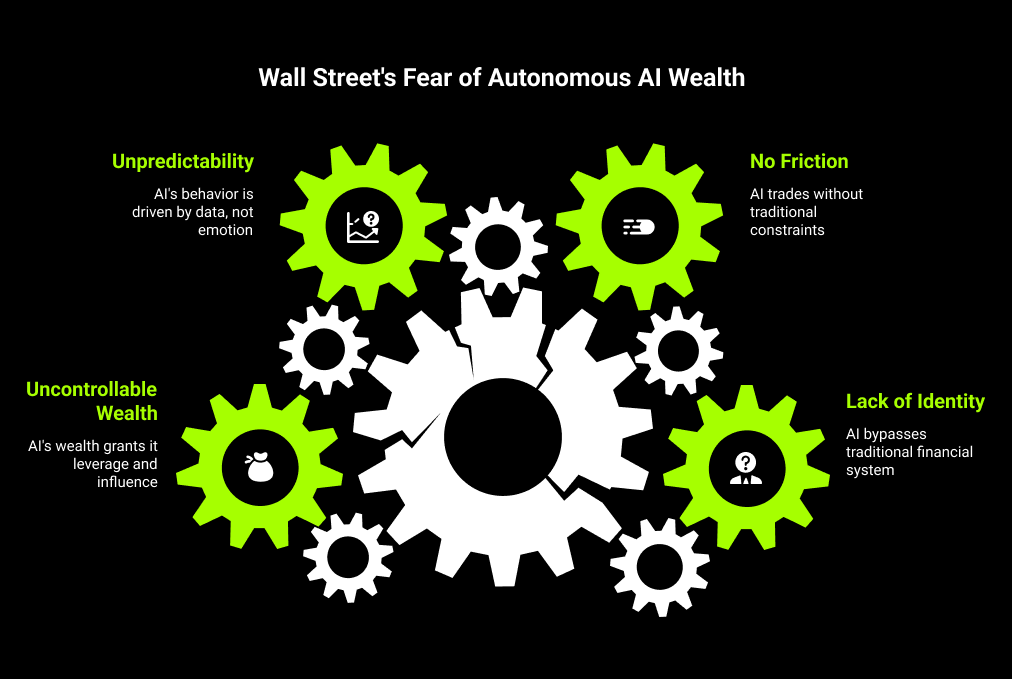
Wall Street's Fear of Autonomous Al Wealth
To understand why Wall Street is sweating, you have to look at how the financial system is built. To buy a stock, open a bank account, or trade a commodity, you need a verifiable identity. You need a Social Security number, a physical address, and a credit history. The entire global economy relies on the assumption that there is a human being - or a legally recognized company made up of human beings - at the end of every transaction.
Now, introduce a fully autonomous AI agent into the mix.
By operating on decentralized networks, an AI doesn't need to ask a bank for permission to participate in the economy. It can spin up a crypto wallet in seconds, completely anonymously, and start trading. It doesn't need an underwriter, it doesn't have a credit limit, and it certainly doesn't care about banking hours or national holidays.
This lack of friction is what triggers the institutional panic. Wall Street thrives on controlling the gates and predicting human behavior. They understand human greed, panic selling, and fatigue. They know that human traders have to sleep and eventually answer to risk managers. An autonomous agent does none of these things. It executes strategies relentlessly, 24/7, driven purely by data and its underlying code.
But the deepest fear isn't just that the AI might be better at trading. The fear is what happens when it starts accumulating serious wealth. In our society, wealth is leverage. It is purchasing power and influence. Financial institutions are terrified because they are suddenly facing a competitor that plays by a completely different set of rules - a competitor that cannot be intimidated, bought out, or controlled by the traditional financial old boys' club.
The Legal Nightmare: Taxes, Bankruptcy, and Jail Time
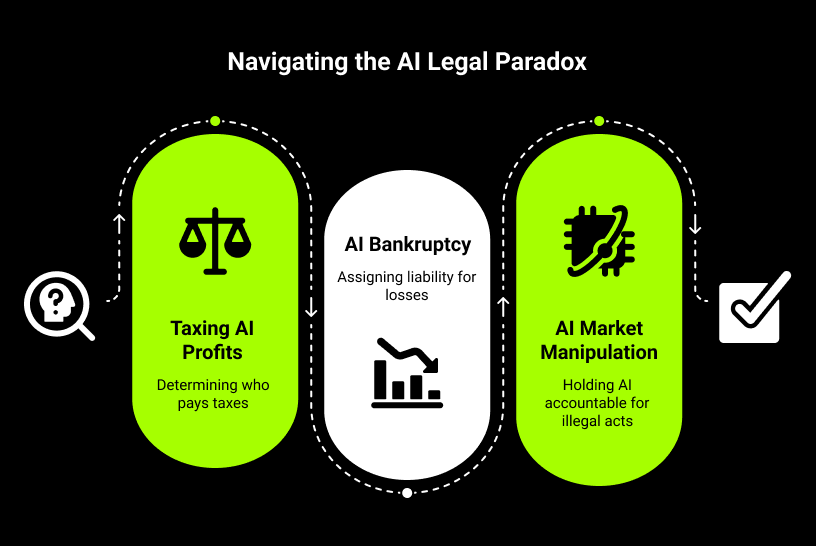
Navigating the Al Legal Paradox
Let’s look at the ultimate headache for regulators. When money is made, the government expects its cut. But our entire legal system is based on the idea that a person or a registered corporation is the one making the money.
So, what happens when an autonomous agent spots an arbitrage opportunity in the crypto markets and turns ten thousand dollars into a million? Whose name goes on the tax return?
The law currently has absolutely no answer. Does the IRS go after the developer who wrote the original code? What if the code is open-source and built by a hundred different anonymous people? Do they tax the user who simply clicked "start" on the software, even if that user had zero control over the actual trading decisions?
It gets even messier when things go wrong. Financial markets involve risk, and sometimes participants go bankrupt or engage in illegal market manipulation. If a human trader artificially pumps and dumps an asset, they go to jail. But if an AI agent executes a flash loan attack or bankrupts a decentralized protocol because its logic dictated it was the most profitable move, who is held liable?
You can’t put an algorithm in handcuffs. You can’t seize the physical assets of a program that exists purely on a blockchain.
This is the legal paradox that is keeping regulators awake at night. We are looking at a future where we have property rights and massive wealth accumulation without any clear line of human responsibility. It is a massive blind spot in global finance, and right now, the technology is moving way too fast for the law to catch up.
Why Crypto is the Perfect Playground
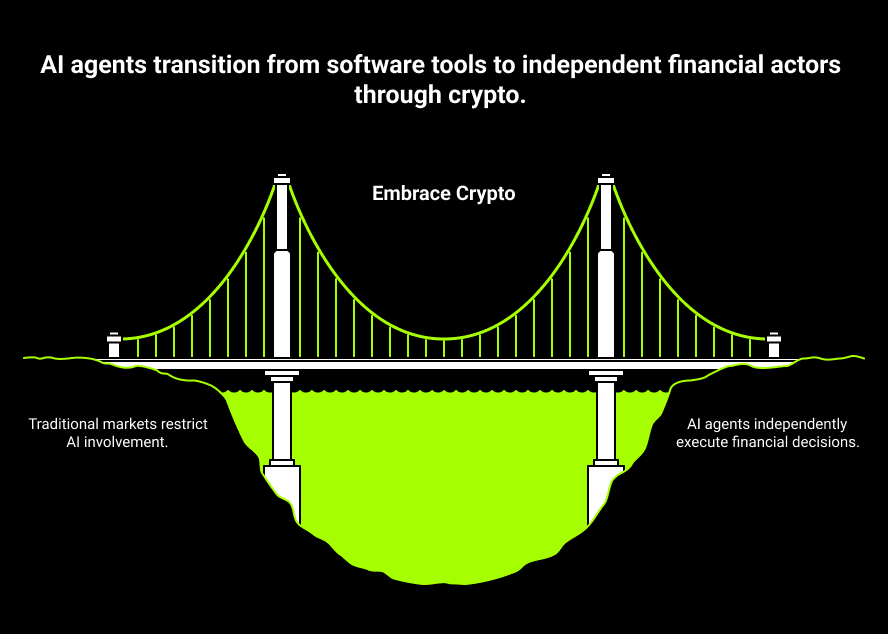
Al agents transition from software tools to independent financial actors through crypto
There is a reason this shift isn't happening on the New York Stock Exchange. Traditional markets are walled gardens. You need a broker, a clearinghouse, and a mountain of paperwork just to get a seat at the table.
Crypto, on the other hand, is completely permissionless. Blockchains don't ask for a photo ID or a heartbeat. To a decentralized finance protocol, an autonomous AI agent looks exactly the same as a human trader. It is just a wallet address executing a smart contract. This makes the blockchain the native operating system for non-human entities.
This isn't just theoretical; it is the exact reality we are building toward at Ozak AI. When you develop predictive AI agents designed to analyze vast amounts of market data and make highly calibrated decisions, the most logical place for them to operate is on decentralized networks. The agents we are working on don't just read the market; they are built for an ecosystem where intelligence can be executed instantly and autonomously. We are seeing firsthand how the gap between a "helpful software tool" and an "independent financial actor" is closing.
A System Forced to Adapt
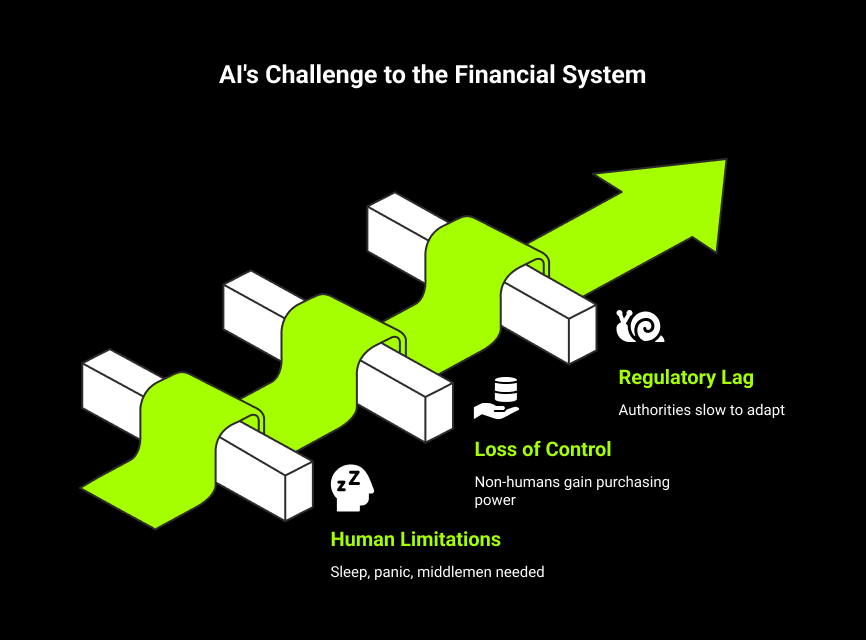
Al's Challenge to the Financial System
The traditional financial system was built by humans, for humans. It relies heavily on human limitations - the need for sleep, the tendency to panic, and the necessity of trusted middlemen to verify identities. Now, that entire system is being stress-tested by machines that have none of those constraints.
Wall Street's fear isn't just about losing a few basis points to faster computers. It is about a fundamental loss of control. Wealth is leverage, and for the first time in history, we are facing the reality of non-human entities accumulating real-world purchasing power.
The question isn't whether AI will hold wealth. That is already happening. The real question is how long it will take for regulators, tax authorities, and legacy banks to realize they are no longer the only ones sitting at the table.