Agent Experience (AX)
For the last twenty years, companies have spent billions of dollars obsessing over User Experience (UX). We track mouse movements, run endless A/B tests on button colors, and optimize layouts just to keep human eyes on a screen for a few seconds longer. The entire architecture of the modern internet is built on a single, unquestioned assumption: a human being is sitting on the other side of the screen, making the decisions.
That assumption is rapidly becoming obsolete.
The primary navigator of the internet is changing. We are entering a phase where AI agents - autonomous programs designed to execute tasks, gather data, and make transactions - are doing the browsing instead. When an AI is tasked with booking a flight, scraping financial data, or analyzing a decentralized market, it doesn't care about your sleek CSS animations or your carefully crafted typography. It cares about one thing: structured, easily digestible data.
This shift from human-first design to machine-first design is what we call Agent Experience, or AX.
This shift represents the next trillion-dollar shift in how digital infrastructure is built. Right now, most of the web is designed exclusively for human attention, which makes it incredibly difficult for machines to navigate. If an AI agent cannot easily read, scrape, and transact with your platform, it will simply skip over you and go to a competitor that is built for machines.
The companies that win the next decade won't be the ones with the best-looking websites. They will be the ones that build the cleanest, most frictionless pathways for AI agents to do their jobs. If your platform isn't machine-readable, it is already invisible.
Defining Agent Experience (AX)
.png?2026-03-11T13:05:58.419Z)
Achieving Agent Experience (AX)
Let's define what Agent Experience actually looks like in practice. For decades, we have built the web for the human eye. We use heavy JavaScript to render dynamic pages, complex CSS for styling, and multi-step forms to capture user intent. That is User Experience.
Agent Experience is the exact opposite. It is about building for the machine, prioritizing structured data over visual aesthetics. Instead of a beautifully designed checkout page or a complex navigation menu, an AI agent wants a clean API endpoint. Instead of a visual dashboard, it needs deterministic JSON outputs and machine-readable contracts.
Consider the developers pushing the boundaries of AI right now. When you are running powerful open-source AI models locally on high-end hardware - like an M4 Pro, for instance - the real bottleneck is rarely the compute power anymore.
The friction happens the moment that model needs to reach out and interact with the open internet to execute a real-world task. If an agent has to parse through a messy web of DOM elements, cookie pop-ups, and layout shifts just to read a price or click a button, the system breaks down.
AX is the infrastructure layer that removes this friction. It strips away the visual noise and provides a direct, unhindered line of communication between the AI and the platform. It is the difference between handing someone a beautifully illustrated map and simply giving them the exact GPS coordinates.
The Cost of Being Machine-Invisible
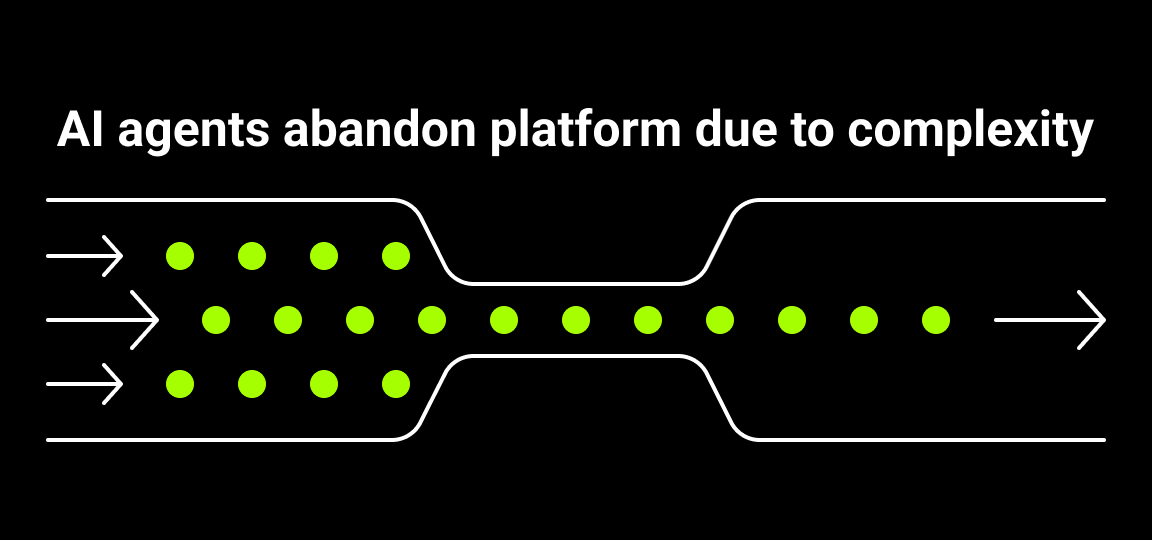
Al agents abandon platform due to complexity
Let's look at the financial stakes of ignoring Agent Experience. For developers, founders, and investors, the math is straightforward: if an AI agent cannot seamlessly read and interact with your platform, you lose the transaction. Period.
Imagine an autonomous agent tasked with finding the most efficient cross-border arbitrage opportunity or executing a high-speed financial trade. It does not have the capability - or the need - to decipher a complex, visually stunning dashboard designed to keep human users engaged.
If the agent hits a wall of CAPTCHAs, unpredictable layout shifts, or unstructured text, it simply aborts the mission and moves to the next available option. That option is usually a competitor with a clean API or a well-structured data layer.
Being machine-invisible means being entirely cut out of the next generation of digital commerce. We are rapidly moving toward a reality where autonomous agents hold the purchasing power and make the split-second decisions. They will be the ones comparing data feeds, reading the smart contracts, and hitting the "execute" button.
If your platform is not structured to welcome them, you are shutting the door on a massive and growing revenue stream. The businesses that force machines to struggle through traditional human interfaces will simply be left behind.
The End of the Eyeball Web
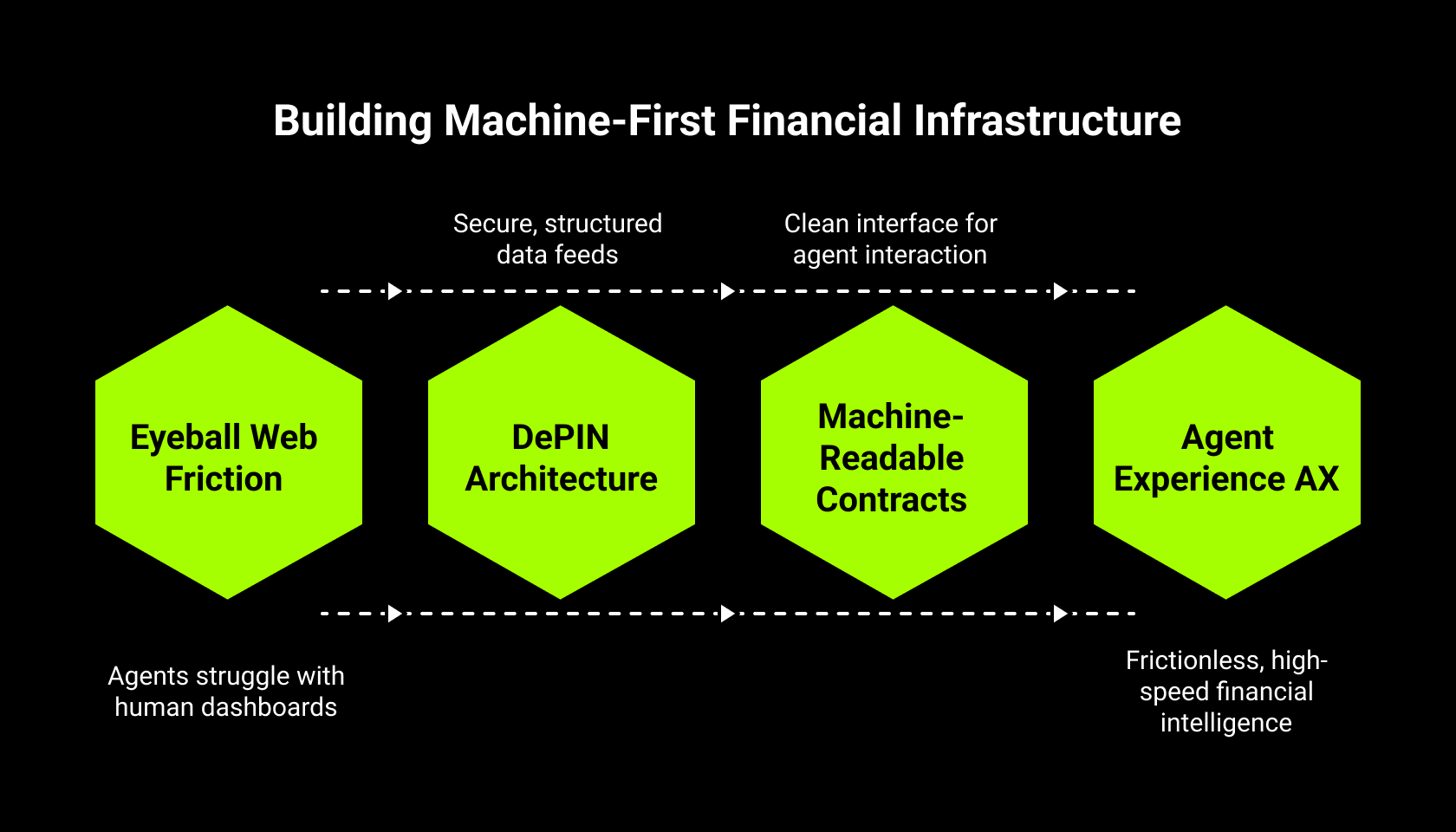
Building Machine-First Financial Infrastructure
Let’s bring this out of the abstract and look at a live environment where Agent Experience is already the defining factor: decentralized finance. At Ozak AI, we are building infrastructure explicitly for this machine-first future.
Our ecosystem relies on Prediction Agents (PAs) - autonomous AI models designed to analyze financial markets, forecast trends, and execute strategies in real-time. For these agents to function accurately, they can't be bogged down trying to scrape clunky, human-facing web dashboards. They require a frictionless, high-speed, and perfectly structured data pipeline.
That is exactly why the Ozak Stream Network (OSN) is built on a Decentralized Physical Infrastructure Network (DePIN) architecture. It isn't designed for human browsing; it is engineered to deliver secure, structured, and deterministic data feeds directly to the agents.
When an Ozak Prediction Agent is looking for a market signal or assessing risk, it interfaces with clean, machine-readable smart contracts and real-time data streams.
This is AX in its purest form. By removing the visual friction that plagues the traditional web, we allow our agents to operate at the speed and precision required for institutional-level financial intelligence.
Conclusion: The Infrastructure Shift
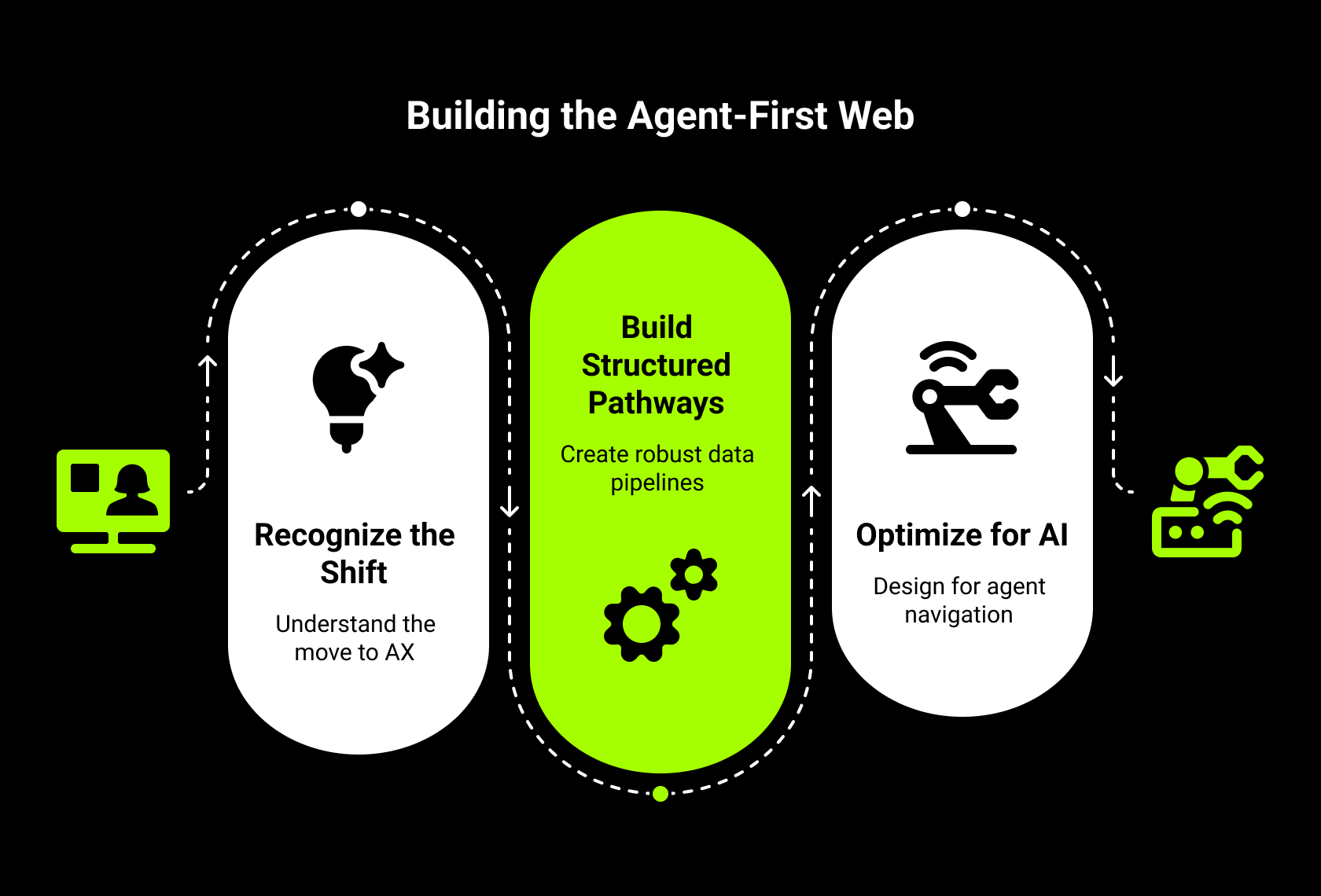
Building the Agent-First Web
The web as we know it is undergoing a fundamental rewiring. The transition from User Experience (UX) to Agent Experience (AX) isn't just a design trend; it is a structural mandate for the next era of the internet.
The companies that capture the next massive wave of capital will be the ones that recognize this shift early. They will stop optimizing exclusively for the human eye and start building robust, structured pathways for AI agents to navigate, scrape, and transact.
The takeaway is simple: if you want to survive the next decade of digital commerce, you have to build for the machines.
AX is the new UX, and the race to build the agent-first web has already begun.