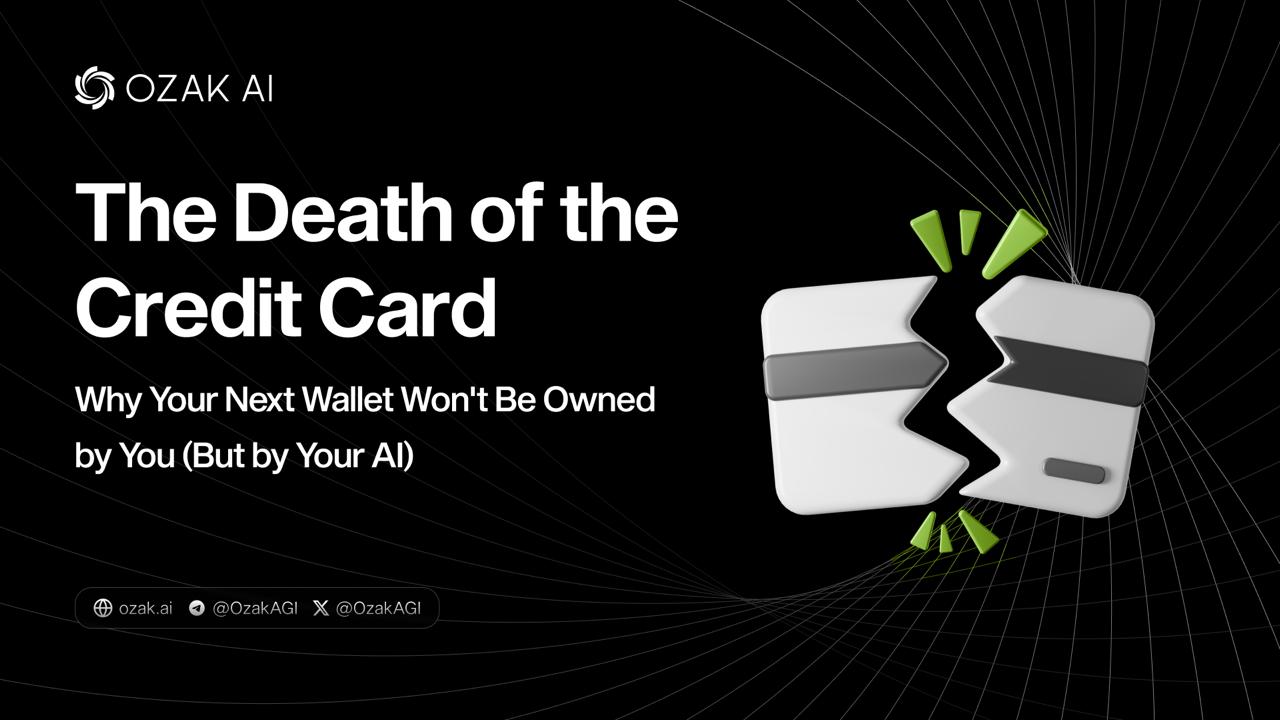
The Death of the Credit Card
Every time you buy something online, pay for a software subscription, or cover a server cost, YOU are the bottleneck.
You have to pull out a piece of plastic, type in a 16-digit number, hunt down a CVV code, or wait for a text message to confirm it is actually you. Even with tap-to-pay and facial recognition, the act of spending money still requires your physical permission every single time.
But that era is ending. The next wallet you own won't be something you keep in your back pocket or load onto your phone. It will be a piece of software controlled by your AI.
We are moving toward a future where daily spending becomes entirely invisible. Instead of you actively clicking "buy" or approving an invoice, your AI agent will handle the transactions for you. It will negotiate prices, pay for digital services, and manage your subscriptions in the background, strictly following the rules and budgets you set in advance.
The daily habit of spending money is about to transform from a manual chore into an automated, sci-fi reality.
Read on.
Agentic Wallets And ERC-4337
Enabling Autonomous Al Transactions
To understand how this works, we need to look at how digital wallets function today.
Right now, most crypto wallets are basically dumb safes. To move money out of them, a human has to show up with a specific key - usually a seed phrase, a password, or a biometric scan - to manually sign off on every single transaction.
That setup is terrible for automation. Software cannot physically tap a screen or hold a private key.
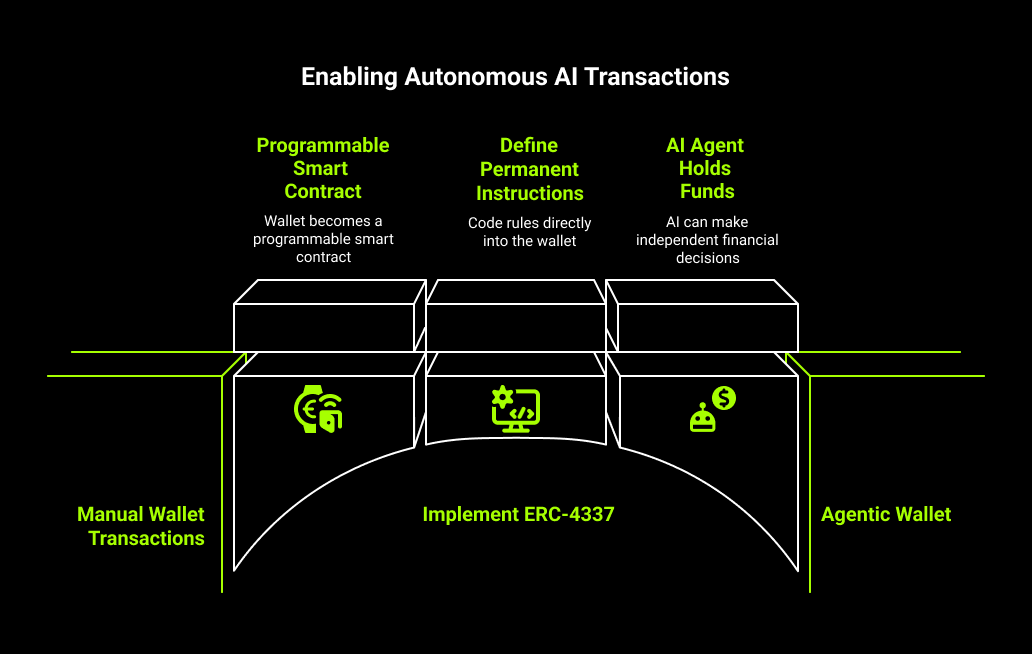
This is where a major technical upgrade called ERC-4337 comes in. Often referred to as Account Abstraction, it essentially turns a digital wallet from a static safe into a highly programmable smart contract.
In everyday terms: you can now code rules directly into the wallet itself.
Instead of requiring a human signature every time money moves, you can give the wallet a set of permanent instructions. You can say, "Allow my AI assistant to spend up to $50 a day on server storage, but permanently block any transaction over $100."
This creates what the industry is calling an Agentic Wallet - a financial tool built specifically for autonomous software rather than human hands.
With programmable guardrails in place, an AI agent can hold its own funds and make independent financial decisions safely. If it needs to ping an API, secure decentralized storage, or buy a stream of real-time market data (the exact kind of predictive fuel platforms like Ozak AI run on), it just executes the payment instantly. It operates purely on the logic and limits you set in advance, completely removing the human bottleneck from the transaction.
Machine-To-Machine Commerce
Machine-to-Machine Commerce Streamlines Business
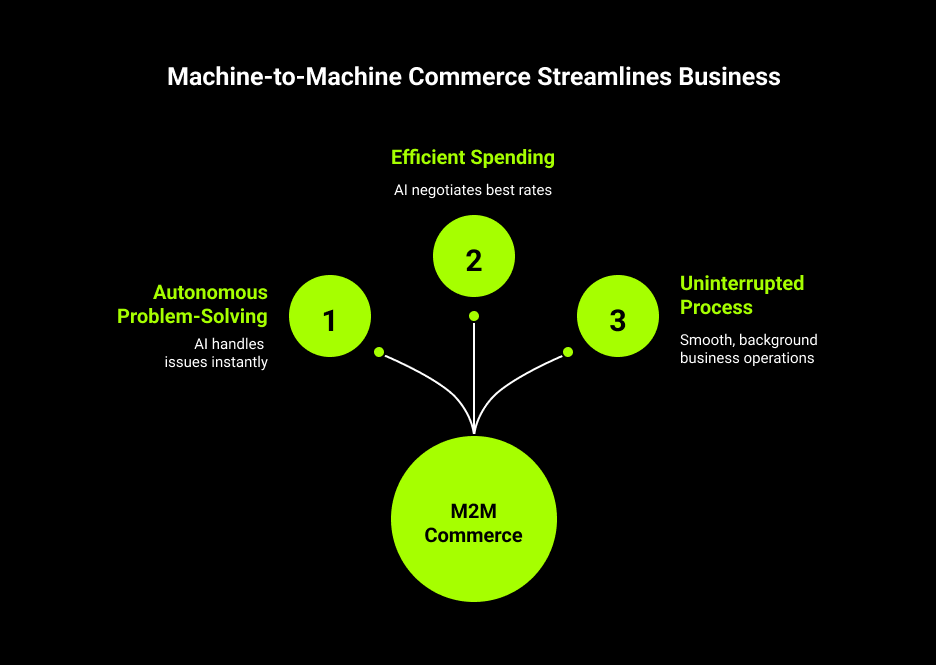
With the human bottleneck removed, we enter the era of machine-to-machine commerce. This is the upside: a completely seamless, invisible economy happening in the background of your business.
Imagine you are running a fast-growing digital project. Right now, if your setup runs out of server space at 3:00 AM, the system either crashes or sends you an urgent alert. Everything pauses until you wake up, compare cloud storage prices, pull out your company card, and manually pay for an upgrade.
In a machine-to-machine economy, your AI agent handles the entire issue before you even start your day. It detects the storage shortage, scans the decentralized market for the best rate, negotiates the terms, and executes a micro-transaction to buy more space instantly. It is autonomous problem-solving paired with autonomous spending.
But to pull this off safely, the AI cannot be flying blind.
For an agent to make smart financial decisions, like knowing which provider offers the best real-time price, it needs constant access to accurate market intelligence. That is where platforms like Ozak AI come into play.
By providing reliable predictive infrastructure and data streams, Ozak AI gives these agents the exact context they need to negotiate and spend efficiently. When the software has the right data and the wallet to act on it, running a business shifts from a series of manual daily chores to a smooth, uninterrupted background process.
Who Takes The Blame?
Al Financial Autonomy: A Legal Minefield
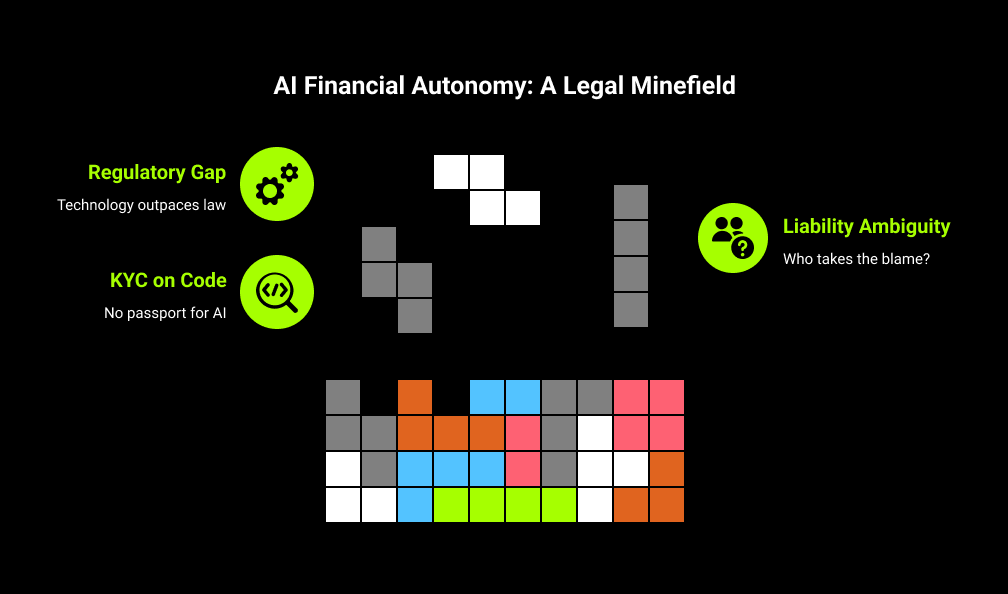
While the technology is incredibly efficient, it is also a massive headache for the legal system. The entire global financial framework - from Know Your Customer (KYC) laws to Anti-Money Laundering (AML) regulations - is built around a single premise: verifying human identities. Banks and regulators need a name, a physical address, and a government ID to authorize who gets to move money around.
An AI agent does not have a passport. When you give financial autonomy to a piece of software using an agentic wallet, it completely breaks the traditional compliance model.
How do you perform KYC on code?
This creates a serious liability problem. Imagine your AI agent is programmed to find the absolute cheapest decentralized storage available. In its autonomous search, it ends up purchasing server space from an entity that happens to be on an international sanctions list. Or, imagine it executes hundreds of tiny micro-transactions to optimize API costs, which an automated bank system suddenly flags as money laundering.
If the AI breaks a financial law, who takes the blame? Is it the developer who wrote the core model, the user who set the budget, or the protocol that hosted the wallet? Right now, there is no clear answer.
Regulators are used to freezing bank accounts and subpoenaing actual people. Tracking and policing autonomous machine-to-machine commerce requires a totally new legal framework, and the gap between the technology's capabilities and current financial law is widening every day.
The Brain Behind The Wallet
Ozak Al's Role in Agentic Wallets
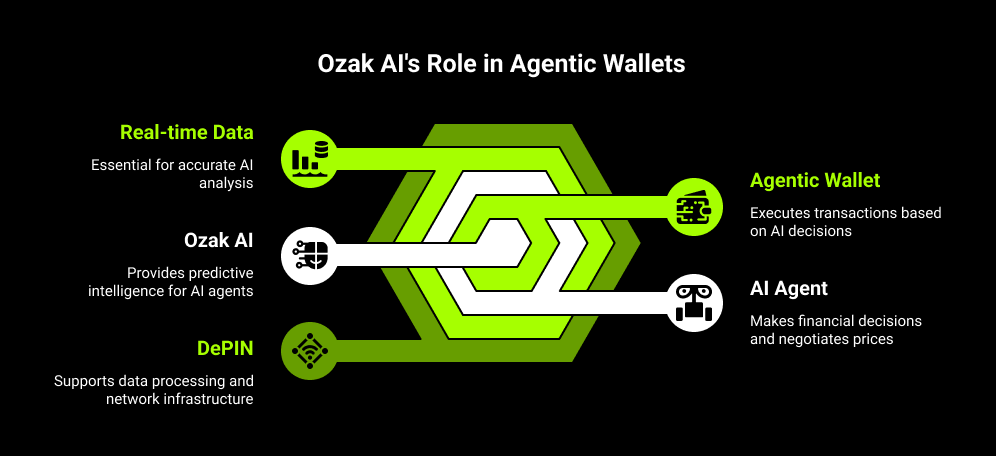
An agentic wallet is just an engine. On its own, it does not know what a good deal is or when a market price is fair. For an AI agent to actually negotiate prices and make smart financial decisions, it needs a continuous stream of flawless, real-time data. If the data is delayed or manipulated, the AI makes bad trades or overpays for services, and the entire system falls apart.
This is where Ozak AI comes in. You can think of an agentic wallet as the hands that execute the transaction, but Ozak AI provides the brain.
By combining artificial intelligence with a Decentralized Physical Infrastructure Network (DePIN), Ozak AI supplies the exact kind of predictive intelligence these autonomous agents rely on. Its network processes massive amounts of market data in milliseconds, filtering out the noise to deliver accurate, tamper-proof signals.
When your AI assistant realizes it needs to buy more server space or execute a micro-transaction, it does not just guess. It pulls real-time insights from Ozak AI's prediction agents to verify the current market rate, assess the risk, and confirm it is getting the best possible deal before it ever moves a cent.
Without a reliable stream of market intelligence, giving software its own wallet is a fast way to lose money. Ozak AI acts as the necessary guardrail, ensuring that when machines spend money on our behalf, they do it safely and efficiently.
A New Kind Of Ownership
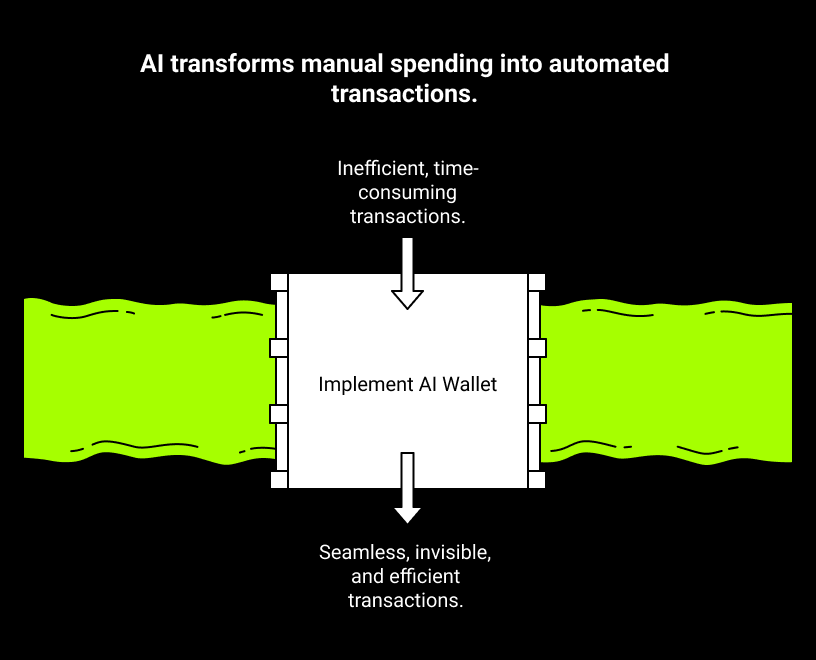
Al transforms manual spending into automated transactions
The transition to agentic wallets fundamentally changes what it means to own your money. In the past, financial control meant physically holding a card or guarding a password. In the very near future, control will mean holding the rules.
You might not carry a wallet in your pocket or tap your phone at a digital checkout anymore. Instead, your ownership will be defined by the parameters you set for your AI: the daily budgets, the approved vendors, and the specific goals you want it to achieve. As long as the agent is fed with reliable, real-time data, like the predictive intelligence Ozak AI provides, it will operate safely within those exact boundaries.
We are standing on the edge of a massive shift in how the digital economy operates. The daily habit of spending money, tracking invoices, and negotiating digital costs is about to become completely invisible.
Your next wallet won't be something you actively use; it will be something that quietly works for you.