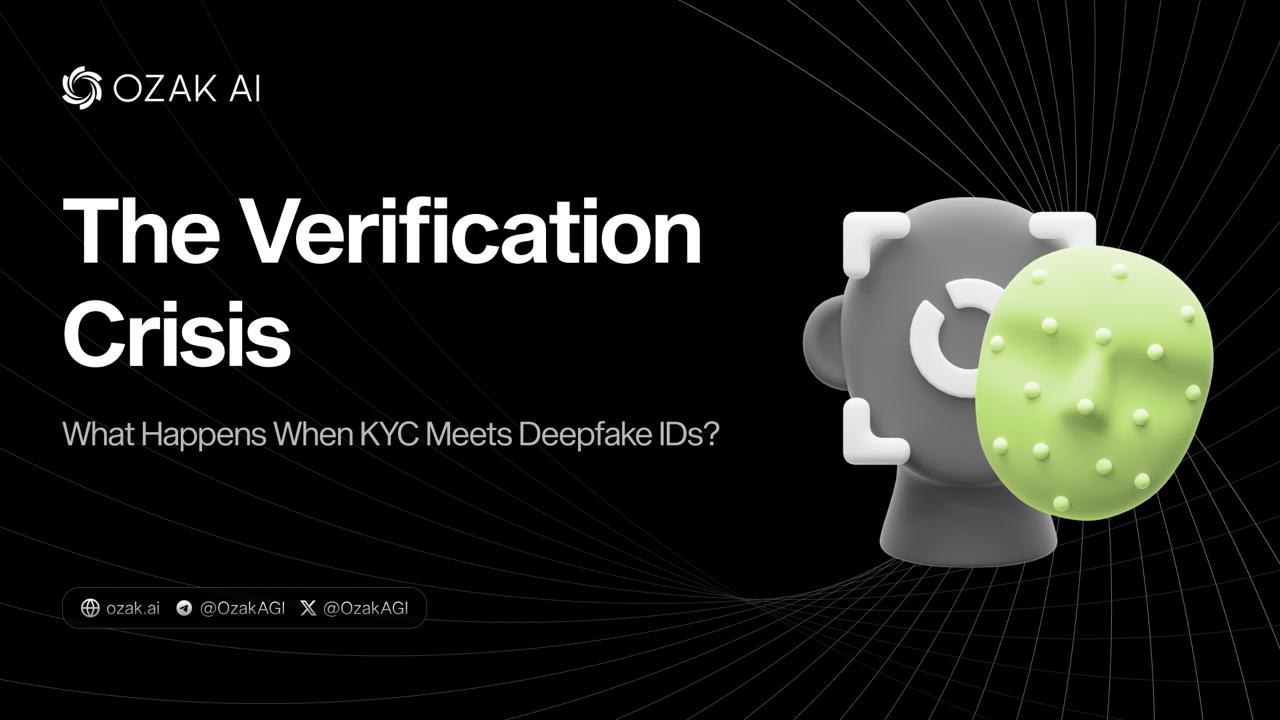
The Verification Crisis: When KYC Meets Deepfake IDs
For years, proving who you are on the internet has boiled down to a simple, familiar routine. You hold your driver's license or passport up to your webcam, snap an unflattering selfie, and maybe slowly turn your head from side to side so the software knows you are a real, living person. It is the standard gateway for almost everything, from opening a traditional bank account to getting verified on a crypto exchange. We accepted this clumsy process because, for the most part, it worked. The system relied on a very basic human assumption: seeing is believing.
That baseline of trust is now broken.
Generative AI has evolved past the point of creating funny images or writing code; it has effectively commoditized the ability to forge reality. Today, a bad actor doesn't need to steal a physical passport or hire a lookalike. With a few dollars and a few minutes of processing power, they can generate a flawless, high-resolution ID that passes basic machine checks. More concerningly, they can map a synthetic face onto a live video feed. An attacker can smile, blink, nod, and answer security questions on a live verification call, completely bypassing the safety nets designed to keep fraud out.
We are standing at the edge of a verification crisis. The digital identity systems that hold the global financial infrastructure together are quietly collapsing under the weight of deepfakes. If an algorithm can effortlessly forge the visual proof we have relied on for decades, the entire concept of "Know Your Customer" (KYC) suddenly has a fatal flaw. We are rapidly approaching a point where a video of a person holding an ID proves absolutely nothing at all.
The Immediate Threat to Crypto and Banking
When the fundamental premise of KYC fails, the immediate blast radius covers both traditional banking and the cryptocurrency sector. Both industries operate under strict regulatory mandates to keep bad actors out of the financial system. For years, the main line of defense against money laundering, financial crime, and basic fraud has been that visual checkpoint.
Now, imagine the scale of the problem when that checkpoint is bypassed not by a few skilled fraudsters, but by automated software. With deepfakes, attackers aren't just slipping through the cracks; they are industrializing identity theft. A single entity can now spawn thousands of synthetic identities, complete with forged government documents and live-generated video feeds, allowing them to open verified accounts at scale.
For crypto exchanges, which often face the heaviest scrutiny from global regulators, this is a nightmare scenario. If bad actors can easily spin up thousands of verified "mule" accounts using AI, they gain a direct, untraceable pipeline to wash stolen funds, execute coordinated market manipulation, or exploit promotional rewards. When the dust settles, the exchanges face massive regulatory fines for failing to catch the fraud, simply because the fake accounts looked exactly like legitimate users.
Traditional banks aren't immune, either. As they push for fully digital onboarding to cut costs and improve the customer experience, they are walking straight into the same trap. If the banking system cannot definitively prove that the person on the other side of the screen is a real human, the entire onboarding funnel breaks down. Financial institutions will soon be forced to make a difficult choice: either accept catastrophic levels of fraud, or fall back on slow, expensive, in-person verification at physical branches. It is a threat that doesn't just cost money - it threatens to drag digital finance back to the 1990s.
The Fix: Cryptographic Proofs vs. Web of Trust
If we can no longer trust a webcam, we have to rethink verification from the ground up. The financial and crypto industries are currently split into two main camps to solve this problem: cryptographic proofs and the Web of Trust. Both approaches abandon the outdated idea of "seeing is believing" and replace it with either hard math or provable reputation.
The first approach leans heavily into cryptography and hardware. Instead of showing a picture of an ID, users provide a mathematical guarantee that they are a unique human being. A prominent, albeit controversial, example is Worldcoin, which uses custom hardware devices to scan a user's iris. The core logic is that while a face on a screen can be deepfaked by software, a physical scan of a complex biological trait using dedicated hardware is significantly harder to spoof. Combine this with zero-knowledge proofs - a way to cryptographically prove a statement is true without revealing the underlying data - and you get a system where you can prove you are a real person without actually handing over your identity. The main trade-off here is the immense friction. Distributing specialized hardware globally is a massive logistical hurdle, and people are understandably hesitant to hand over biological data to tech companies.
The second approach is the Web of Trust. Rather than searching for a physical or biological anchor, this method focuses entirely on a user's digital footprint. It operates like a decentralized version of someone vouching for you. A synthetic identity created by a bad actor ten minutes ago might have a perfect AI-generated passport, but it has no real history. A genuine human, on the other hand, has a messy, complex web of on-chain transactions, long-held assets, and a history of interacting with different networks over time. By analyzing this behavior, systems can assign a reputation score based on actual activity rather than a static ID check.
While the Web of Trust is more privacy-friendly and doesn't require retinal scanners, it has its own flaws. Most notably, it creates a "cold start" problem. It is incredibly difficult for a brand-new, legitimate user to access financial services because they haven't had the time to build up a digital reputation yet.
The Ripple Effect on Networks and Data
The collapse of visual verification doesn’t just hurt centralized banks and crypto exchanges; the damage bleeds directly into the decentralized networks we are building next. When bad actors can automate fake identities, the pollution spreads from the onboarding layer down to the data layer. For next-generation platforms, identity isn't just about regulatory compliance anymore - it is about the fundamental integrity of the network itself.
This is exactly why the verification crisis is a critical issue for platforms like Ozak AI. In an ecosystem built around DePIN (Decentralized Physical Infrastructure Networks) and agentic workflows, every participant acts as a node of information. Ozak AI is designed to process real-time financial intelligence and power predictive analytics. But an AI model is ultimately only as smart as the data feeding it.
If a decentralized network relies on community sentiment, transaction history, or node operation to gather market intelligence, that network must be heavily protected against Sybil attacks. If someone uses deepfakes to spin up ten thousand verified but synthetic accounts, they aren't just opening empty wallets - they are flooding the ecosystem with garbage data. They can manipulate sentiment, skew predictive models, and ultimately weaponize the network's own AI against its genuine users.
For platforms pushing the boundaries of decentralized intelligence, the shift away from "seeing is believing" isn't optional. Whether through cryptographic proofs or a robust Web of Trust, establishing that a data point comes from a unique human being is the only way to keep the intelligence clean. If you cannot definitively trust the participant, you cannot trust the data. And in the world of predictive financial analytics, compromised data is entirely useless.
Conclusion: Adapting to the New Baseline
The transition away from visual KYC is not going to be smooth. For years, users have been trained to expect a quick, frictionless selfie check, and moving toward cryptographic proofs or requiring users to build on-chain reputation will inevitably add hurdles to the onboarding process. But it is a necessary growing pain.
As new digital ecosystems scale, particularly those navigating token generation events and distributing assets to early adopters, ensuring that participants are verified humans is no longer just a compliance box to check. It is the foundation of network security and fairness. If a project cannot filter out sybil attacks, its resources and data are quickly drained by automated bots.
We have crossed a threshold where algorithms can seamlessly replicate reality. In a world where AI can forge a passport, clone a voice, and spoof a live video call, "seeing is believing" has become a dangerous liability. Moving forward, the only way to prove we are real is to leave the visual checks behind and rely on the unforgeable math of cryptography and the earned weight of our digital history.